
Who Is Liable for a Truck Accident in Illinois: The Driver or the Trucking Company?
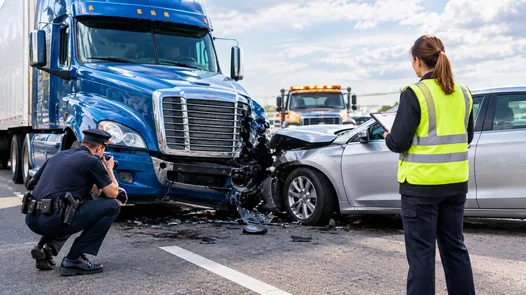
A loaded semi drifts into your lane on the interstate. The crash happens fast, and the next few hours blur. Before you leave the hospital, someone from the trucking company's insurer is already calling to "check on you."
That call raises a fair question. Who actually has to pay for what happened to you? In Illinois, the answer is often more than one party. The driver may be responsible, the trucking company may be responsible, and sometimes both are. Knowing how those pieces fit together matters, because the company usually has the insurance and the records. Here is how liability works in a truck accident case.
Why Truck Crashes Are Different in Illinois
The stakes are high. The Illinois Department of Transportation's 2024 Illinois Crash Facts & Statistics report counted 11,294 crashes involving tractor-trailers that year, including 91 fatal ones. Those crashes made up 3.7 percent of all crashes but 8.4 percent of the deadly ones.
The people hurt are mostly not inside the truck. Of the 106 people killed in tractor-trailer crashes, 15 were truck occupants. Another 83 were in other vehicles, 7 were pedestrians, and one was in a non-motor vehicle. A truck weighs many times more than a car, so the damage lands on everyone around it.
The Driver Answers for Their Own Mistakes
Start with the person behind the wheel. A truck driver has to drive with reasonable care, just like anyone else. Speeding, tailgating, texting, drifting out of a lane, or driving while exhausted can all be negligence. Our guide on how to prove negligence walks through what you have to show.
Still, suing only the driver rarely makes sense. Most drivers cannot pay a serious injury claim out of their own pocket. The company that employs or hires them usually carries the insurance. Federal rules set a minimum of $750,000 for many for-hire carriers hauling regular freight in vehicles over 10,000 pounds, and some carry more.
When the Trucking Company Pays for the Driver's Mistake
Illinois follows a rule called respondeat superior. It means an employer can be responsible for what its employee does on the job. The Illinois Supreme Court explained how courts decide whether the conduct was on the job in Pyne v. Witmer, 129 Ill. 2d 351 (1989). Conduct is within the scope of employment if it:
- Is the kind of work the person was hired to do
- Happens substantially within the authorized time and place
- Is meant, at least in part, to serve the employer
A driver hauling a load on a dispatch fits that test almost perfectly. If a company driver causes a crash on the way to a delivery, the company is usually responsible for that driver's negligence.
What If the Driver Is Called an Independent Contractor?
This is where trucking companies get creative. Many label their drivers "owner-operators" instead of employees. The label matters because Illinois generally does not hold a hiring company responsible for an independent contractor's mistakes. The Illinois Supreme Court repeated that rule in Carney v. Union Pacific Railroad Co., 2016 IL 118984. It also repeated the main exception: a company can be liable when it keeps some control over how the work is done.
Control is the key word. Federal leasing rules say a carrier that leases a truck must have "exclusive possession, control, and use of the equipment" and "assume complete responsibility for the operation of the equipment." Injury lawyers often use that language to argue the carrier answers for a leased driver, whatever the paperwork says.
A contract label does not settle it. Lawyers look at who dispatched the load, who set the delivery deadlines, whose name was on the truck door, and who controlled the routes. The real working relationship counts more than the title.
The Company Can Be Responsible for Its Own Choices
A trucking company can also be at fault for its own decisions, separate from anything the driver did. Illinois recognizes claims for negligent hiring and retention. Under Van Horne v. Muller, 185 Ill. 2d 299 (1998), you must show the employer knew or should have known the employee had a "particular unfitness" for the job, and that this unfitness caused your injury.
In trucking, that might look like a company that hired a driver with a record of serious violations, kept a driver after repeated safety warnings, or pushed delivery schedules that encouraged tired driving. It might also mean skipped brake repairs or poor maintenance. Illinois has adopted much of the federal safety rulebook, including the driver qualification, hours-of-service, and maintenance rules, for carriers that stay within the state under 625 ILCS 5/18b-105. Trucks that cross state lines follow the federal rules directly.
Here is an important point. In McQueen v. Green, 2022 IL 126666, the Illinois Supreme Court held that an employer admitting it is responsible for its worker does not shut down a direct negligence claim. If there is a good-faith factual basis, you can pursue both. So a trucking company cannot make its own mistakes disappear by simply saying, "Yes, he works for us."
Records That Show Who Was in Charge
The paperwork often tells the story. Useful records include the lease or contract between the driver and the company, dispatch messages, delivery schedules, the driver's qualification file, inspection and repair records, and the bill of lading for the load. Together they show who gave the orders, who knew about problems, and who got the truck ready for the road.
You cannot get most of these on your own. A lawyer can request them early, and once a lawsuit is filed, demand them through discovery.
Other Parties That May Share the Blame
Sometimes the driver and the company are not the whole story. Depending on the facts, a repair shop that did faulty brake work, a loading company that packed cargo badly, or a parts maker with a defective product may also be responsible. Another driver who caused the chain reaction could be as well. These claims take investigation, which is one reason to act early.
How Shared Fault Affects Your Claim
Truck companies and their insurers often argue the other driver caused the crash. Under 735 ILCS 5/2-1116, an Illinois plaintiff more than 50 percent at fault recovers nothing. At 50 percent or less, the award shrinks by your share. Our article on being partially at fault explains the basics.
Why You Should Not Wait
Trucking companies and their insurers often move quickly after a serious crash. Electronic data, driver logs, and maintenance records can be overwritten or discarded on a schedule, and they may be gone before you have even hired a lawyer. Our guide on what evidence helps a claim covers what to gather yourself.
The clock is also running. Illinois generally gives you two years to file a personal injury lawsuit under 735 ILCS 5/13-202.
Talk to a Truck Accident Lawyer Early
Sorting out who owns the truck, who employs the driver, and who carries the insurance is hard from a hospital bed. The attorneys at Panio Law Offices handle truck accident claims for clients in Chicago and the south suburbs. Contact the firm for a free consultation, and do not give the insurer a recorded statement before you talk to someone on your side.
Frequently Asked Questions
Can I sue both the truck driver and the trucking company in Illinois?
Yes, in many cases. The driver may be responsible for their own negligence, and the company may be responsible for the driver's conduct on the job or for its own hiring and maintenance choices.
What if the truck driver was an independent contractor?
That does not automatically protect the company. Illinois courts look at who really controlled the work, and federal leasing rules require carriers to take responsibility for leased equipment they operate under. A lawyer can look at the contract and the real day-to-day facts.
If the company admits the driver worked for it, can I still make a negligent hiring claim?
Yes. In McQueen v. Green, the Illinois Supreme Court held that an admission of responsibility for the employee does not bar a direct negligence claim, as long as there is a good-faith factual basis for it.
How much insurance does a trucking company have to carry?
Federal rules set a minimum of $750,000 for many for-hire carriers hauling nonhazardous freight in vehicles over 10,000 pounds. Some carry more, and the exact policy depends on the company and the load.
How long do I have to file a truck accident lawsuit in Illinois?
Most personal injury lawsuits must be filed within two years of the injury. Talk to an attorney as soon as you can, since evidence in trucking cases can disappear quickly.
Hurt in a truck accident and not sure who is responsible?
Contact the experienced Chicago personal injury attorneys at Panio Law Offices today for a free consultation and find out who is liable for what happened to you.